
Ashley Bennett, Staff Writer.
You are standing at the bathroom sink, phone in hand, scrolling past a dozen spinning brush heads and silicone pads that all promise the same thing: cleaner, brighter, smoother skin by tomorrow. Somewhere in a drawer nearby is the one you bought last year, half-charged, unused since March. The question you actually type into the search bar is not “best facial cleansing brush” — it is closer to “do these things even work, or am I just going to scratch up my face again?”
Here is one fact worth knowing before you spend another dollar: a facial cleansing brush cannot make a cleanser work better than the cleanser itself. The brush’s job is mechanical — loosening debris and buildup — while the actual cleaning chemistry still comes from the formula you pair it with, according to dermatologist Dr. Claire Dubois. Understanding that single distinction reframes almost every buying decision that follows.
- The motor matters less than the bristle or pad material — soft silicone and fine synthetic bristles clean effectively for most skin types, while stiff natural bristles can create micro-tears invisible to the eye.
- Speed and vibration count are marketing numbers, not proof of better cleansing — dermatologists point to consistent, gentle technique over 60 seconds as the real driver of results.
- Overuse, not the device itself, causes most of the irritation reported with cleansing brushes — two to three sessions a week is the ceiling most skin can tolerate without disrupting its barrier.
What A Cleansing Brush Actually Does To Your Skin

Think of your skin’s surface the way you might think of a kitchen counter after cooking dinner. Wiping it with a dry cloth moves crumbs around. Wiping it with a soapy sponge, worked in small circles, lifts grease and residue the cloth alone could never budge. A facial cleansing brush works on the same principle: it does not replace the soap, it helps the soap reach further into pores and along the texture of the skin.
“The bristle or silicone contact agitates the cleanser so it can loosen sebum, sunscreen residue, and light makeup more evenly than fingertips alone,” notes Dr. Claire Dubois, board-certified dermatologist. That agitation is mechanical exfoliation in miniature — useful, but not a substitute for the active ingredients that treat acne, pigmentation, or texture.
Where people get into trouble is assuming more agitation equals more benefit. Skin is not a countertop. It has a barrier — a thin layer of lipids and cells that keeps water in and irritants out — and that barrier can be disrupted by too much mechanical action, regardless of how gentle the marketing claims the bristles are.
Bristle Material Versus Vibration Speed: What To Weigh First
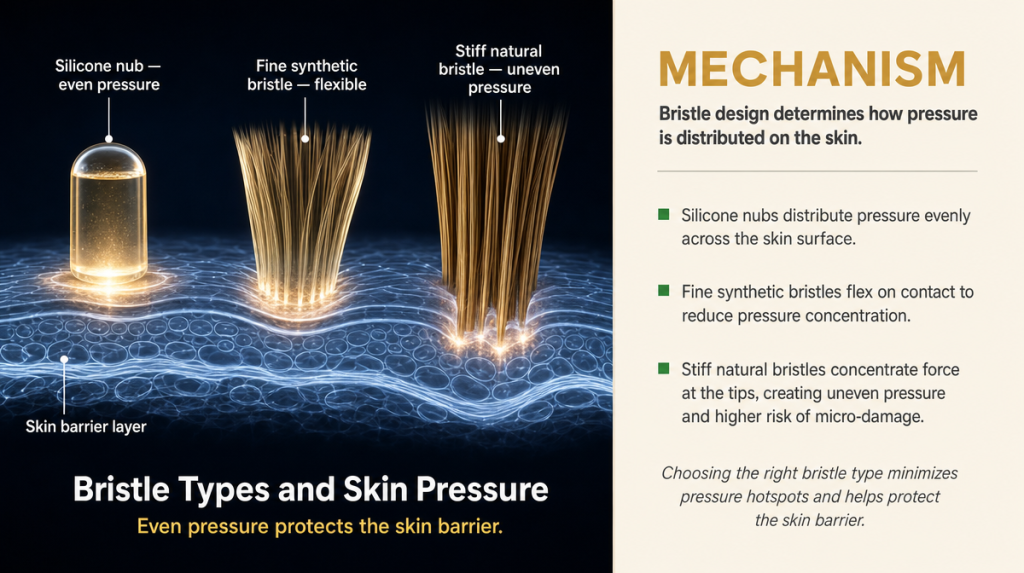
Manufacturers love to advertise oscillations per minute or sonic vibration counts, numbers that sound scientific and are easy to compare on a shelf. But biochemist Dr. James Morrison, whose research background covers how topical ingredients interact with the skin barrier, points out that speed specifications say little about safety or outcome.
“What determines whether a device is gentle enough for daily contact is the material touching the skin and the pressure the user applies, not the motor’s rated speed,” he explains.
In practice, this means a slower device with soft, closely spaced silicone nubs or fine synthetic bristles may be gentler and just as effective as a faster one with coarser bristles. Natural bristle brushes, often marketed as more “spa-like” or premium, can actually be stiffer and less consistent in diameter, which raises the odds of micro-abrasion, particularly around the cheeks and nose where skin is thinner.
The practical takeaway: when comparing two devices, run a bristle across the inside of your wrist first. If it feels sharp, scratchy, or uneven there, it will feel the same — or worse — on facial skin that sees daily sun exposure and thinner barrier support.
The Mistakes Almost Everyone Makes With These Devices
The most common error is frequency. A device marketed for daily use may still be too much for skin that is already compromised by retinoids, exfoliating acids, or seasonal dryness. Professor Margareta Lindberg, whose research has focused on skin barrier function, cautions that combining a mechanical brush with chemical exfoliants on the same day is one of the most frequent sources of redness she sees discussed by patients.
The second mistake is pressure. Newer users often press the device into the skin the way they would scrub a dish, when the correct technique is closer to guiding the brush across the skin and letting the bristles do the work. Excess pressure does not clean more thoroughly; it simply increases friction against the barrier.
The third mistake is hygiene. A brush head sitting damp in a humid bathroom — especially during humid East Coast summers — becomes a place where bacteria can multiply between uses. Rinsing the brush head thoroughly and letting it air-dry fully, rather than storing it in a closed case while still wet, is a small habit with an outsized effect on breakout risk.
Finally, people expect immediate results and abandon a reasonable routine after a week when skin looks slightly pink or feels tight, mistaking normal adjustment for an adverse reaction, when in fact it may simply mean the frequency needs to drop.
Judging Results: What To Actually Look For, And By When
Realistic expectations start with understanding what a cleansing brush can and cannot change. It can improve how thoroughly makeup, sunscreen, and daily grime are removed, which in turn helps other products in a routine absorb more evenly. It does not treat acne, reduce fine lines, or fade dark spots on its own.
Most users who tolerate a device well notice smoother texture to the touch within one to two weeks of consistent, moderate use — roughly two to three sessions weekly. Any visible change to pore appearance or breakout frequency, if it occurs, tends to show up more gradually, often over four to six weeks, and results vary by skin type and existing routine.
A useful self-test: after a cleansing session, wait ten minutes and look at your skin in natural daylight, not bathroom lighting. Mild, brief pinkness that fades quickly is common and not concerning. Persistent redness, tightness, or small bumps that appear repeatedly after use are signals to reduce frequency or switch to a softer material, not signs to push through.
What Is Genuine Engineering And What Is Shelf Marketing
Waterproof ratings, app connectivity, and multiple speed settings are conveniences, not indicators of cleansing performance. A device does not need Bluetooth to clean skin effectively. What is worth paying attention to, according to Dr. James Morrison, is whether the brush head is replaceable and how often the manufacturer recommends swapping it.
“Bristles and silicone surfaces degrade with repeated use and cleaning products,” he notes. “A worn head can harbor residue regardless of how advanced the motor inside the handle is.”
A brush head that shows fraying, flattened bristles, or a cloudy silicone surface after a few months has likely outlived its usefulness, even if the handle still works perfectly. Manufacturer guidance on replacement schedules — typically every three months for bristle heads — is worth following more closely than any spec about vibration frequency.
Another point sometimes lost in marketing: a higher price does not reliably correlate with gentler materials. Some premium devices at the top of the drugstore or department store shelf use the same silicone formulations found in far less expensive versions. The material and the fit against your particular facial contours matter more than the price tier.
Matching A Device To Your Skin Type, Not The Marketing Model
Oily and thicker skin types can generally tolerate slightly firmer bristles and more frequent use, since sebum production offers some buffer against friction. Dry, thin, or visibly reactive skin does better with soft silicone options used less often, particularly through dry winters with indoor heating, when the barrier is already working harder to retain moisture.
Skin with active breakouts warrants particular caution. Dermatologists commonly advise against running any brush, however soft, directly over inflamed or open blemishes, since mechanical contact can spread bacteria to surrounding skin. In these cases, hands and a gentle cleanser may serve better until the flare calms.
A short self-test before buying: press the bristle head lightly against the inner forearm for ten seconds. If the skin looks visibly indented, red, or irritated afterward, that same pressure held against facial skin, which is thinner and more sensitive, is likely to be too much for daily use.
Key Takeaways
A cleansing brush is a mechanical helper, not a treatment — it works only as well as the cleanser paired with it. Material and technique matter more than motor speed or smart features. Two to three uses a week is the realistic ceiling for most skin, and hygiene between uses is not optional.
A Quick Checklist Before You Buy Or Restock
- Test the bristle or silicone against your inner wrist before assuming it will suit your face
- Choose replaceable brush heads and follow the manufacturer’s replacement schedule, generally every three months
- Limit use to two or three sessions weekly unless a dermatologist advises otherwise
- Rinse and fully air-dry the brush head after every use
- Avoid running any brush over active breakouts or freshly exfoliated skin
- Judge results in natural daylight, not bathroom lighting, and give a routine four to six weeks before deciding
Sources
1. American Academy of Dermatology, public guidance on skin barrier care and mechanical exfoliation, 2024
2. Mayo Clinic, patient guidance on acne care and skin cleansing practices, 2023
3. Good Housekeeping Institute, general consumer testing commentary on personal care devices, 2023
Professor Margareta Lindberg, MD, PhD — Dermatologist and researcher specializing in skin aging, barrier function, and connective tissue.
Dr. James Morrison, PhD — Biochemist specializing in dermal delivery and formulation science.
Dr. Claire Dubois, MD — Board-certified dermatologist with expertise in cosmetic dermatology and skin aging.
This article is for general information and does not replace personalized medical advice from a licensed dermatologist.
Individual results vary depending on skin type, routine, and consistency of use.