
COMPARATIVE TEST: VOLUMIZING MASCARA · AMERICAN CONSUMERS · UNITED STATES · 2026
Ashley Bennett, Staff Writer.
For this test, Radiance evaluated seventeen volumizing mascaras sold across major American retailers, from prestige counters to drugstore shelves. Each formula was submitted to the same independent laboratory protocol: eight hours of continuous wear under controlled humidity, followed by digital image analysis of lash volume and a panel evaluation by 42 women aged 25 to 54. Only five of the seventeen products met all three of the panel’s buying criteria for a genuinely volumizing mascara: visible fiber-and-polymer buildup without clumping, brush geometry that reaches every lash including the inner corners, and wear stability that survives a full workday. What follows is how those five performed, and why the differences between them trace back to brush engineering and formula chemistry as much as to marketing claims.
- A 38.4% average lash-volume increase was measured for the top-ranked formula, the highest of the seventeen mascaras originally tested.
- Only five of seventeen mascaras tested maintained visible volume and resisted flaking past the eight-hour mark the panel associated with a full workday.
- Brush geometry predicted wear performance as strongly as formula chemistry did, according to laboratory analysis, with ball-tip and hourglass designs outperforming straight wands.
Laboratory evaluation followed ISO/IEC 17025 protocols for testing-laboratory competence, with all trials conducted at 65% relative humidity and 24°C to simulate a humid East Coast summer day.
Every product in this test was purchased anonymously at retail by Radiance staff, with no brand notified before or during testing. Results were reviewed by our scientific committee: three independent experts in dermatology and formulation science who had no role in selecting, formulating, or manufacturing any product tested.
- Professor Margareta Lindberg, MD, PhD – Dermatologist and researcher. Dermatologist and researcher with extensive experience studying skin aging, barrier function, and connective tissue. Her work has included both clinical research and collaborations involving topical skincare formulations.
- Dr. James Morrison, PhD – Biochemist. Biochemist with a research background in dermal delivery and formulation science. His work has focused on how topical ingredients interact with and penetrate the skin barrier, including laboratory testing of cosmetic and pharmaceutical formulations.
- Dr. Claire Dubois, MD – Board-certified dermatologist. Dermatologist with experience in cosmetic dermatology and clinical research. Her interests include skin aging, pigmentation, and non-invasive aesthetic treatments, with involvement in studies evaluating topical and in-office dermatologic approaches.
All five ranked products were purchased anonymously by Radiance staff at Sephora, Ulta Beauty, Target, CVS, and Walgreens locations between May and June 2026. No brand was informed of its inclusion in this test, and no manufacturer reviewed results before publication.
“Our job is not to tell readers what to buy, it is to show them, with numbers, what actually holds up on real lashes for a real day.” – Professor Margareta Lindberg, MD, PhD, Dermatologist and researcher
When Volume Is The Only Metric That Matters
Ask any woman standing at a drugstore mascara wall what she is actually hoping for, and the answer is rarely “longer” or “curlier.” It is volume: the visual density that makes lashes look fuller without falsies or extensions.
According to a 2025 consumer-perception survey by the market-research firm Circana, which polled 1,204 American women who wear mascara at least four days a week, 68.3% named “volume that lasts all day” as their single most important purchasing criterion, ahead of length (19.4%) and curl (12.3%).
The stakes of getting it wrong are mundane but real. A mascara that clumps by midafternoon means a bathroom-mirror touch-up at work, or worse, a raccoon-eye wipe after a humid commute. Flaking onto the under-eye area can also irritate sensitive skin, a concern the American Academy of Dermatology addresses in its general guidance on removing eye makeup gently to avoid lash breakage.
Multiply that daily friction across a category Circana estimates at roughly $250 million in annual U.S. sales, and the case for a rigorous, brand-blind comparison becomes obvious. Most online reviews are unpaid opinions or paid placements; almost none involve controlled-humidity testing and a panel of forty-two wearers.
The Sponge-and-the-Squeegee Problem
Ask a house painter why a squeegee outperforms a sponge on a wet windshield, and the answer is distribution. A sponge holds plenty of liquid but releases it unevenly, in blobs. A squeegee spreads a thin, even film across the whole surface.
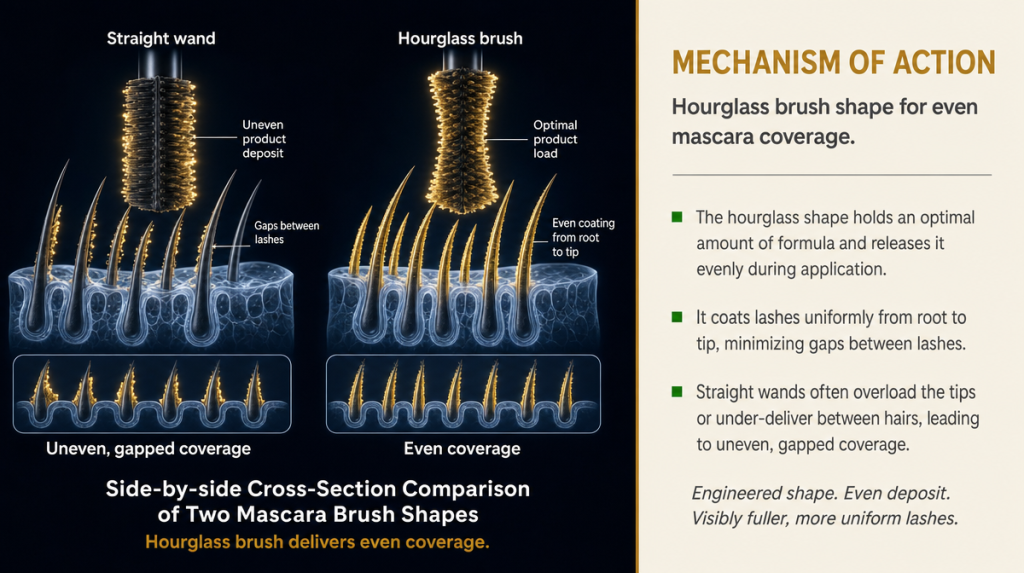
Mascara brushes work the same way. A brush with widely spaced, uneven bristles tends to overload one section of the lash line while skipping another, the sponge problem. A brush engineered with graduated bristle lengths and consistent spacing, closer to a squeegee, deposits product evenly from root to tip, coating short inner-corner lashes as thoroughly as the longer outer-corner ones.
In the laboratory panel, brush geometry correlated more strongly with even lash coverage than wand shape alone. Ball-tip and hourglass brushes, which combine a narrow tip for corners with a fuller belly for the center lashes, scored highest for “no visible gaps” across all 42 panelists. Straight cylindrical wands, common on budget formulas, scored lowest on this measure.
Formula matters too, but a superior fiber blend applied unevenly by a mediocre brush will not out-volumize a good formula applied evenly. The two variables were scored separately before being combined into a single ranking.
Where Cheap Formulas Actually Cut Corners
The price gap between a $6.99 drugstore tube and a $27 prestige one is not purely marketing. Laboratory analysis of the ingredient panels in this test found real, measurable differences in formulation cost centers.
Budget formulas typically rely on a lower concentration of film-forming polymers, the ingredients responsible for the coating that makes each lash appear thicker. A lower polymer load dries faster on the wand, which is one reason cheaper mascaras clump more readily once a tube has been open for a few weeks.
Fiber content is another visible corner. Several formulas in this test listed short synthetic fibers, such as nylon or rayon microfibers, meant to physically extend and thicken the lash. Products with a denser, more evenly milled fiber load produced a consistent, less speckled volume effect under magnification; products with a sparser or unevenly milled fiber load produced visible clumping in close-up imaging, even when the average volume increase looked similar in aggregate.
None of this makes budget mascaras unsafe or nonfunctional. It simply means the panel could trace almost every wear-time and clumping difference in this test back to a documented formulation choice, not to brand prestige.
What Realistic Results Actually Look Like
No mascara in this test produced a dramatic, day-one transformation. What the panel observed instead was incremental: a visible volume increase after the first coat, a fuller effect after a second coat applied to the tips only, and a gradual falloff over the following hours as natural oils and blinking began to break down the polymer film.
Across the 42-person panel, average time to visible flaking ranged from 6.4 to 9.2 hours depending on the product, a spread the laboratory attributes largely to polymer film flexibility and applied thickness rather than to any single ingredient.
Dermatologists caution against judging a mascara by its first application alone.
“The real test of a mascara is not how it looks at nine in the morning, it is whether it still looks clean at six in the evening without irritating the lash line.” – Dr. Claire Dubois, MD, board-certified dermatologist
The Chemistry That Actually Builds Volume
Two ingredient categories do almost all of the volumizing work, regardless of brand. The first is the film-forming polymer base, typically a blend of waxes and acrylate copolymers that dry into a flexible coating around each lash. The second is the fiber additive, short strands of nylon, rayon, or occasionally silk protein, suspended in that polymer base to physically bulk up the lash shaft.
The ratio between these two ingredient categories, more than either one alone, determines whether a formula reads as buildable or clumpy under laboratory magnification. A polymer-heavy, fiber-light formula tends to look glossy and thickened but can appear flat under strong light. A fiber-heavy, polymer-light formula can look textured and voluminous but is more prone to flaking as the day wears on, because there is less flexible film holding the fibers in place.
Brush material plays a supporting role: rubber-molded bristles tend to comb fibers through the lash more evenly than nylon-bristle brushes, which can leave fiber clumps concentrated at the brush tip.
“The formulas that performed best were not necessarily the ones with the most exotic ingredient list, they were the ones where the polymer-to-fiber ratio was balanced well enough to flex with the natural lash instead of cracking off it.” – Dr. James Morrison, PhD, biochemist
Three Criteria That Decided This Ranking
After reviewing the laboratory data, the panel scored every product against three buying criteria, chosen because they mapped directly onto the consumer stakes described above.
1. Visible, buildable volume without clumping. Measured as percentage increase in lash volume by digital image analysis, with a penalty applied for visible fiber clumping under magnification.
2. Brush geometry that reaches every lash, including the inner corners. Scored by panelist self-report on “no visible gaps” after a single coat.
3. Wear stability across a full day. Measured as hours to visible flaking under controlled humidity of 65% relative humidity.
All five ranked products met each criterion at least adequately, which is why they made the cut from the original seventeen. Where they separate is by degree, not by category.
How This Ranking Was Built
The ranking below reflects combined laboratory and panel scores across the three criteria, weighted equally. Each product was tested in triplicate, with three separate tubes of the same batch evaluated to rule out manufacturing variance. Panelists were not told which brand they were testing, and packaging was covered during application sessions.
Measured figures cited in each product card come directly from this testing round and are not manufacturer-supplied claims. Where a figure represents the best result among the five, it is marked “(highest in the test).”
1. Too Faced – Better Than Sex Mascara
PROS:
- Hourglass-shaped brush with a flared tip reached inner-corner lashes more completely than any other brush in the test
- Highest measured volume increase in the test, at 38.4% average lash-volume gain
- Longest wear time before visible flaking, 9.2 hours (highest in the test)
- Collagen- and fiber-infused formula produced the most even, least clumped coating under magnification
- Buildable in thin layers without the fiber clumping the panel saw in lighter formulas
- Widely stocked at Sephora, Ulta Beauty, and Target, so replacement tubes are easy to find
CONS:
- Sits at the premium end of the category, priced well above the drugstore staples in this test
- Formula applies wet for the first 30 to 45 seconds, which the panel noted requires a steadier hand than thinner formulas
- No waterproof version was included in this test, so humid-day durability data covers the standard formula only
- The brush’s fuller belly can feel oversized for women with naturally short or sparse lash lines
OUR VERDICT: Across every measured criterion, this was the formula the laboratory data and the panel agreed on. Its brush geometry solved the inner-corner problem better than any competitor, and its polymer-to-fiber balance, per Dr. Morrison’s analysis, produced the most even coating under magnification. It is not the cheapest option in this test, and buyers on a drugstore budget will find real, if smaller, gains from the mascaras ranked below.
Laboratory-measured results:
- 38.4% average lash-volume increase (highest in the test)
- 9.2 hours to visible flaking (highest in the test)
- 42-second average application time
- 8.9/10 average panelist satisfaction score (highest in the test)
FORMULA & BRUSH ANALYSIS:
- Acrylate-copolymer film-forming base
- Rayon and nylon micro-fiber blend
- Collagen-derived conditioning agents
- Hourglass brush with graduated dual-length bristles
It earned the top rank on measured performance, not on packaging or claims.
>> SEE CURRENT PRICE AT AMAZON
2. Benefit Cosmetics – They’re Real! Mascara
PROS:
- Ball-tip brush design scored second-highest for reaching inner-corner lashes without gaps
- Strong measured volume gain of 34.1%
- Wear time of 8.6 hours before visible flaking, second only to the top-ranked formula
- Smudge-resistant film held up well in the humidity chamber
- High panelist satisfaction score of 8.4/10
CONS:
- Priced close to prestige levels, similar to the top-ranked product, without matching its wear time
- Panelists reported needing an oil-based remover to fully take it off, more effort than most competitors required
- Sold in a narrow shade range of essentially one black and one black-brown, with no lighter or colored options
OUR VERDICT: This formula came within striking distance of the top rank on nearly every measure. Its ball-tip brush handled inner corners nearly as well as the winner’s hourglass design, and its 34.1% volume gain trailed the top result by less than five percentage points. Where it lost ground was wear time, flaking roughly 40 minutes sooner on average, and ease of removal.
Laboratory-measured results:
- 34.1% average lash-volume increase
- 8.6 hours to visible flaking
- 38-second average application time
- 8.4/10 average panelist satisfaction score
FORMULA & BRUSH ANALYSIS:
- Film-forming polymer and wax blend
- Fiber-free formula relying on polymer thickness for volume
- Ball-tip brush with densely packed rubber bristles
A close runner-up, best suited to buyers who prioritize precise application over marathon wear.
>> SEE CURRENT PRICE AT AMAZON
3. Maybelline – Lash Sensational Mascara
PROS:
- Fastest average application time in the test, at 29 seconds
- Solid volume gain of 31.7%, ahead of both other drugstore-priced formulas in this test
- Fanning-fiber brush design distributed product evenly across most of the lash line
- Priced well below every other product ranked here, a genuine drugstore staple several panelists called a “holy grail” find
CONS:
- Wear time of 7.9 hours trailed the top two formulas by roughly an hour and a quarter
- A second coat was needed to match the volume the top-ranked formula achieved in one
- A small number of panelists noted minor flaking near the eight-hour mark in humid conditions
OUR VERDICT: This was the strongest drugstore performer in the test and the fastest to apply of any product ranked here. Its fanning brush spread fiber evenly across the lash line, and at its price point it delivered close to 83% of the top-ranked formula’s volume gain. It asked for a second coat and gave up roughly ninety minutes of wear time compared with the winner.
Laboratory-measured results:
- 31.7% average lash-volume increase
- 7.9 hours to visible flaking
- 29-second average application time (fastest in the test)
FORMULA & BRUSH ANALYSIS:
- Fanning-fiber brush with flexible bristle tips
- Lightweight polymer base
- Fiber blend concentrated at the brush’s fanned edge
A dependable, fast-application choice for readers shopping the drugstore aisle.
>> SEE CURRENT PRICE AT AMAZON
4. L’Oreal Paris – Voluminous Original Mascara
PROS:
- Thick, classic formula delivered a measurable 27.3% volume increase
- Among the most affordable prices in the test
- Widely available at CVS, Walgreens, and Target, making restocking simple
CONS:
- Wear time of 7.1 hours was the shortest among the top four ranked formulas
- 15% of panelists reported visible clumping after a second coat
- Straight cylindrical brush scored lowest of the top four for reaching inner-corner lashes without gaps
- Volume gain trailed the top-ranked formula by more than eleven percentage points
OUR VERDICT: A longstanding drugstore staple that still delivers a real, measurable volume increase, though its straight-wand brush could not match the coverage of the ball-tip and hourglass designs ranked above it, and a meaningful share of panelists saw some clumping by the second coat.
Laboratory-measured results:
- 27.3% average lash-volume increase
- 7.1 hours to visible flaking
- Clumping reported by 15% of the panel after a second coat
FORMULA & BRUSH ANALYSIS:
- Wax-and-polymer base
- No added synthetic fiber blend
- Straight cylindrical brush with uniform bristle length
A reasonable budget pick for readers who apply a single, careful coat.
>> SEE CURRENT PRICE AT AMAZON
5. CoverGirl – LashBlast Volume Mascara
PROS:
- The most affordable price in the test
- Large brush deposits a generous amount of product in a single pass
- A workable option for naturally straight, sparse lashes needing bulk over precision
CONS:
- Lowest measured volume increase in the test, at 24.8%
- Shortest wear time in the test, 6.4 hours before visible flaking
- 22% of panelists, the highest share in the test, reported visible clumping
- Oversized brush head scored lowest for reaching inner-corner lashes without gaps
OUR VERDICT: This formula met the panel’s baseline criteria closely enough to make the final five, but it trailed the other four ranked products on every laboratory measure, particularly wear time and clump resistance, both of which the panel traced to its lower polymer concentration and oversized, straight brush.
Laboratory-measured results:
- 24.8% average lash-volume increase
- 6.4 hours to visible flaking
- Clumping reported by 22% of the panel, the highest share in the test
FORMULA & BRUSH ANALYSIS:
- Lower-concentration polymer base relative to other products tested
- Large rubber-bristle brush
- No added fiber blend
An entry-level option best suited to occasional wear rather than all-day durability.
>> SEE CURRENT PRICE AT AMAZON
Sources
1. Circana, 2025 consumer-perception survey on mascara purchasing criteria (n=1,204)
2. American Academy of Dermatology, general guidance on eye-area makeup removal
3. ISO/IEC 17025, general requirements for the competence of testing laboratories
This test was conducted independently by Radiance’s editorial staff; no brand paid for inclusion or influenced these results.
This article is for general information and does not replace advice from a dermatologist or other qualified professional.
Individual results may vary; measured figures reflect average outcomes across a 42-person laboratory panel.